Blog 8: Group project research

One of the biggest issues about sexual assault is that it is not as relevant as it should be. This is why for our group project we have decided to focus on spreading awareness. This is not only to demonstrate a supportive community were sexual assault victims can feel comfortable to share their stories, but as well shedding a light on the importance of it. This is why for or campaign we decided one of the best ways to spread the word is through hanging up posters in the college. On this poster we will have a statistic on it, the goal is to get college students more aware of this issue. For instance; one of the statistics that really stood out to my group, and I was; One in five women experience sexual assault while attending a post-secondary institution.” via cfsontario.ca The reason why we all agreed that this statistic would be an excellent choice for our poster, is because it’s personal. Many students who have not experienced or heard about sexual assault do not realize how often this act can occur. This is why this statistic would be perfect because its get’s them thinking that they know women who have been sexual assault but has not said anything. For example: The girl you sit next to every music class has been sexually assaulted, but you have no idea, because in your mind sexual assault “barely” happens. Just because you don’t hear stories, or have experienced it yourself, does not mean it rarely happens. If anything, the reason why you probably never heard anyone talk about their sexual assault story is because they’re scared too, they don’t feel comfortable. The reason they don’t feel comfortable is because people are not properly aware of the seriousness of the topic.

  • Only 1 in 3 Canadians understand what sexual consent means.
  • One in three women will experience some form of sexual violence in their lifetime.

http://sacha.ca/system/attachments/600/medium/ywca_sexual_assault_infographic.jpg?1444318277

As well the reason why we decided to promote our campaign on a poster, rather than social media is because they’re so many things that are trending on social media. People get to choose what they search online, while a poster if it’s placed in front of your locker, or in a certain staircase, eventually you will read it. Even though you’re not planning on reading you will because you pass by it everyday, at one point it will finally catch your attention. Social media is great resource when it comes to spreading news, but sexual assault is news that needs to be spread around everyday, instead of just when a story about a sexual assault victim is trending.

“Posters can increase knowledge, change attitudes and alter behaviors.”  https://www.mimeo.com/blog/scientifically-proven-the-effectiveness-of-posters/  In other words our main goal for this campaign!!!!!!!!!

Karina Veloce

Blog 6: International women’s week

During the women March week, David presented his speech concerning on the increase of male violence that is within our society and culture. He explained his claims based on his experience as someone who works on an organization call white ribbon that is fight against toxic masculinity and make changes in manhood in order to prevent more victimized women having to be perpetuate by the action of Male masculinity.

One of the key message that I understood from the speaker is that his goal was too help men and boys to violence on women and girls whether it involves men in acts of domestic abuse, sexual violence, homicide assaults targeted women just like the incident of the polytechnic massacre.

My thoughts during the presentation was not as surprising that I could imagine because I myself was already aware of the increase of Male violence that we have in our society. Whether it be the crimes among men’s which is consider way more than the average women who commits illegal activities themselves, or the suicide rate among males is also ridiculously high which I think it has to do a lot with how our society projects men to be with masculinity.

Furthermore, I would personally recommend for people to take consideration on what the white ribbon are trying to accomplish by helping men and boys who struggle fitting in to society and are at time engaged in violence on women whether it be physically or verbally, and the self-harm they are inflicting on themselves.

Blog 2: The World of Gender

In the essay human beings: an engendered species by Jacqueline Holler, when she explains in her title essay on the meaning of mean difference. What I understood so far about gender and its importance is that gender from what that author researched is socially constructed, and can be very diverse depending on the countries cultural norms that a country would find acceptable for a male and women to physically or mentally be as.

I think the reason why gender differences is deem important to us as individuals is probably because it is what make us able to identify our identities and culture as people. Moreover, I also think the reason why we as individual humans we cling to the notion of gender is most likely because without gender there is no society, and what I mean by that is our masculine and feminine role exist for the success of our society. As proof, our society as human with gender still live until this day.  

The evidence that the author proves that men and women are not from Venus and Mars is due to the reason of the author stating in the last paragraph that as humans we are the one who the rules and constitutions in our society to decide on what our gender should be as an identity for our culture and society.

Blog 4: Chemaly Rage & emotional labour

Soraya Chemaly wrote a book base on women of all race going through the emotional labour whether the emotional labour takes place in households or work fields.

In Chemaly works, she describes various kind of emotional labours that women experience that are differently from the average males in our patriarchy society which are putting women in a below category and are still treated with unfair gender inequality. For example, she describes about women’s in household work, and how emotionally it drains them in providing everything for their kids, and husband while receive little to satisfy their need.

Moreover, she also explains how women of ethnicity and class are consider to be vulnerable socially and economically because our society is heavily male dominate which make women always feel to be consider as second class or more what Chemaly would say “what feel like dismissal”.

Furthermore, she states how women and mothers in society feels that our society is not taking women going through emotional labours into serious consideration, but rather claims that they used for granted. which I think, this would obviously anger anyone who feels despite the hard work they put in their fields they are in and yet whatever issues or problem that were to happen to them whether it be at work or home were to be consider as nothing more than a pastime that can easily be brush off.      

Blog 8:

group project.

My group and I decided to focus our project on the coronation between rape victims and the clothing they were wearing at the time of the assault. Many individuals choose to ask the victim what they were wearing as if that was the reason for the assault. Upon research I found that “what were you wearing” is a very common question and many of the times ends up convincing the victim that somehow it might be there fault. Bringing awareness to this problem is extremely important especially due to the fact that fashion is getting “sexier” as the generations are going by. What people have to realize is that it doesn’t matter if you are wearing pants or a skirt, you could be a rape victim regardless of the attire worn. The article below is one of many exhibits that demonstrates the myth of clothing being the reason for the assault.

https://www.independent.co.uk/life-style/rape-victims-clothes-displayed-brussels-belgium-debunk-victim-blaming-myth-a8152481.html

The fact that people justify an assault due to the type of clothing one wears is ridiculous and goes all the way back to elementary school. Many articles wrote about school dress codes and how wearing a longer skirt at school will keep the girls “safe”. As if the length of a skirt would determine your chances of being sexually violated.

https://www.washingtonpost.com/posteverything/wp/2016/04/13/why-dress-codes-cant-stop-sexual-assault/?utm_term=.f995c0d400eb

Our group chose this subject because of how relatable it is to our age and generation. We see and hear it everyday through verbal and physical actions. Wether it’s walking down the street being cat called or getting grabbed at a club, it is all around us and our clothing should not be blamed for the actions of others.

https://mic.com/articles/141781/here-are-9-times-clothing-was-blamed-for-sexual-assault-rather-than-the-obvious#.KNOKow3EW


#ThisIsNotConsent

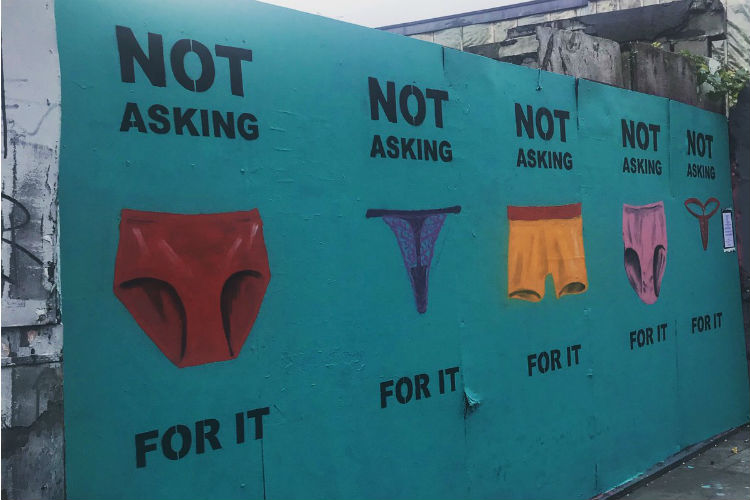
The “#ThisIsNotConsent” movement went viral due to the shameful arguments brought in court in Ireland concerning a rape victim. A young women of 17 years old was a rape victim who was brave enough to take it to court only to be discredited, embarrassed and watch the man that caused her so much pain go free. When the court decided that the type of underwear this women was wearing meant she “wanted it” and that it was not considered rape because of her choice in lacy underwear, the world exploded in outrage. This movement went viral due to social media. Many held protests out side of the court, posted pictures and articles in this women’s defence. Giving her a voice, and even though the court did not vote in her favour, this movement was able to touch everyone world wide. It not only touched the lives of women, but taught men never to assume a women “wants it” just on the looks of her underwear. Furthermore, this movement also reached to law enforcements and political figures who have the power to make real change so that this would not repeat in the future. When it comes to sexual violence many don’t realize that it’s never okay to just assume and clothing plays a big role in that due to our society’s norms. Women, teenagers in particular wear very revealing outfits not necessarily for others or because they want sex but to feel confident in their own skin. Clothing doesn’t mean “I want sex” its a form of expression and anyone who justifies raping another because the victim was wearing lacy underwear is observed. It’s crutial to spread awareness especially now a days were it is simply a button away.

Related image
Image result for #thisisnotconsent


Image result for #thisisnotconsent

Blog 8: Group Project Research

For our group project, we wanted to address the topic of sexual assault at large, and focus on just raising awareness. Our target is both survivors and bystanders. For survivors, it is to assure them they are not alone, and also where to find resources. For bystanders, it is to encourage them to help survivors and also informing themselves of resources.

We wanted to accomplish this by stating a fact, one that is simple, yet powerful and really get people to think. We would like to specifically choose a statistic relating to campuses. These are some that I found on :

“One in five women experience sexual assault while attending a post-secondary institution.” via cfsontario.ca

“[…] 44 per cent of female identified students experienced some form of sexual violence or unwanted touching while attending the institution […] only ten students had reported an assault.” via cfsontario.ca

“More than 80 per cent of rapes that occur on college and university campuses are committed by someone known to the victim […]” via cfsontario.ca

“[…] 60 percent of Canadian college-aged males indicated that they would commit sexual assault if they were certain that they wouldn’t get caught.” via cfs-fcee.ca

“[…] 20 percent of male students believed forced sex was acceptable if someone spent money on a date, if the person’s date was stoned or drunk, or if individuals had been dating for a long time.” via cfs-fcee.ca

“[…] about 9,000 people at French-speaking Quebec universities found that 36.9 per cent reported experiencing some form of sexual violence by someone linked to their university.” via macleans.ca

We cannot only state facts, but add something more to it. We need to turn a statistic into a real life situation, and a number into a real person. We need to find a way to make the fact mean something to someone. We thought of saying something like “there are very good chances that this can be someone standing right next to you” or “this means that one in five women you know at the college is most probably a survivor”.

We wanted to turn this into a poster and put it up around the school, this way people are forced to look at it and be reminded of it often. When doing some research, according to http://www.energizeinc.com, bathroom stall doors and areas of “high traffic” are the best locations to target.

Lastly, somewhere on the poster we would like to include some resources. When researching, I found some resources of Quebec Crisis Centres that survivors of sexual violence can contact, many of which have 24 hour crisis lines. There is an extensive list on http://www.casac.ca/node/52.

There is also another site where both survivors of sexual assault, as well as people who have committed sexual assault or feel like they are tempted to can refer to:

https://www.quebec.ca/en/family-and-support-for-individuals/assistance-and-support/help-and-resources-for-sexual-assault-victims-and-sexual-assailants/community-organizations-that-help-victims-of-sexual-assault/.


Blog 8: Group Project Research

The issue that my group will be focusing on is that of consent in relation to clothing. That is, through our campaign idea, we would like to emphasize that no matter what clothing a woman is wearing, she has the right to feel safe. Clothing should never be interpreted as a sign of consent, regardless of how revealing it is.

In a recent court case in Ireland, a 27 year old was accused of raping a 17 year old girl; his lawyer held up the lace thong that the young woman was wearing during the incident of sexual violence, and consequently, the man was acquitted (Safronova, 2018). This being said, it is absurd that in today’s contemporary society, a woman could be blamed for an act of sexual violence against her due to the clothes that she wears. This sparked a lot of emotion in me, and therefore, I would really like to help destroy the idea that clothing could ever be a sign of consent on a global level.

A poll in the United Kingdom revealed that 55% of men and 41% of females believe that more revealing clothing increases a woman’s chances of assault and / or harassment (Oppenheim, 2019). Through this statistics, it is clear that the main target audience of our campaign idea should be males, as the majority in the United Kingdom believe ideas such as these; although this is not completely representative of our society, our cultures are similar and we can assume that there are Canadian men who also believe this same notion.

Some may argue that clothing does not affect rates of sexual violence; however, the issue remains that regardless of whether or not clothing actually affects acts of sexual violence, it is still being used to excuse the behaviour of men who commit these acts, as previously stated regarding the Irish court case.

Following the court case in Ireland in which the accused was acquitted because of the young woman’s thong, the Irish community was outraged and this began a protest. Many individuals, men and women, participated in this protest and it sparked a hashtag: #ThisIsNotConsent (George, 2018). Many people posted pictures of their thongs with this hashtag, and thongs were even being hung all over the country in support of victims who are blamed for violence against them as a result of their clothing. This project began as a protest and carried over to social media, where it mobilized populations across the world. Clearly there was a positive impact, as it raised awareness about injustices regarding sexual violence all around the world.

My group hopes to communicate the same message in order to stop victim-blaming once and for all.

George, K. (2018). Irish women’s ”this is not consent” tweets protest the shocking way this rape trial was decided. Retrieved from https://www.bustle.com/p/irish-womens-this-is-not-consent-tweets-protest-the-shocking-way-this-rape-trial-was-decided-13147976.

Oppenheim, M. (2019). Majority of men believe women more likely to be sexually assaulted if wearing revealing clothing, study suggests. Retrieved from https://www.independent.co.uk/news/uk/home-news/men-sexual-assault-clothes-women-victim-blaming-rape-a8792591.html.

Safronova, V. (2018). Lawyer in rape trial links thong with consent, and Ireland erupts. Retrieved from https://www.nytimes.com/2018/11/15/world/europe/ireland-underwear-rape-case-protest.html.

Blog 7: Sexual Assault Campaign

The “This is abuse” was a campaign created by the government of the UK to target 13 to 18 years old boys and girls to encourage them to understand and comprehend what abuse ,violence, consent and controlling behaviour are with their relationships.These campaigns were shown from 2010 to 2014. Now we can find various videos from this campaign on the internet. The reason why I find it so intriguing is because in my opinion, these campaigns are very raw and demonstrate what sexual assault and other various problems look like with complete transparency.The videos are quite short and easy to find online. I first saw these videos in High school when they would teach us about sexual assaults and violence within a relationship.

Another great campaign that was has definitely spread word is a ad campaign called #WhoWillYouHelp . This ad campaign was created by the Ontario Premier Kathleen Wynne to inform and educate people on what is “not ok” when dealing sexual aggression from some males in our society. According to the Ontario newsroom, this ad campaign recently won 4 awards and has been viewed more than 85 millions times worldwide. This ad campaign has shown a significant . amount of change in people in the age group of 18-29 years old. The #WhoWillYouHelp campaign has also been adapted and shown in other provinces like Manitoba and Saskatchewan. This ad is to encourage people to speak up if they see any bad behaviour happening in a relationship. street, workplace etc.

Blog 7: Sexual Assault Campaign

The campaign that I found really captured my attention. It explains the myth about sexual assault. For example: sexual assault only happens in the dark. Which is clearly not true and just a myth. It could happen to anyone at any time and people need to be aware of it. It also explains how to intervene if you see someone getting assaulted. You could call the cops or you could come to a victims defence and get her or him out of the situation. I also really liked this campaign because they have a support center for victims who have bees sexually assaulted and they could go and talk to someone. People should really know about this campaign because it shows how sexual assault is a problem and really damages people. We should be aware of the fact that no means no, stop means stop, yelling means no, turning away means no and pushing you away means no. If the person doesn’t say yes or no her or his actions are clear enough to let the person know that the victim doesn’t want anything. This campaign does a really great job at showing scenarios of sexual assault. Another example is, it is not sexual assault if the victim doesn’t report to the police. This campaign explained that victims are afraid to go tell the police because they’re scared of what the aggressor might do. The campaign also encourages victims to talk to call their center and talk to someone that could really helped them and keep them safe because it is important to address the issue.

https://www.ontario.ca/page/lets-stop-sexual-harassment-and-violence

In this video it is a girl who went on a date with a guy who supposedly seemed nice and therefore she was into him. He bought her and him drinks. When the date was over he drove her home and told her if he could come in because he was to drunk to drive. The girl let him in and he started kissing her. She kissed him back for a few seconds than told him to back off. He wasn’t backing off he grabbed her and threw her on the bed. The girl kept screaming to back off but he was sexually assaulting her until the girl got really mad. The guy left and she felt miserable and abused. This video really touched me because many people out there makes themselves seem nice just to get what they want. When someone says no once it means no. Even if the person says yes but than changes they’re mind, its totally fine and the person should back off. No one deserves to get abused and this is a major issue, 1/3 girls get sexually assaulted and 1/6 guys get violated. This video is made to spread the message that a no is a no and it shouldn’t be hard to understand. People should be aware of the message that the video is spreading. Even if the girl is not saying no she is still yelling and shoving the person off her. This clearly means she doesn’t want to have sex with the Guyane many guys have trouble understanding that.