Blog 6: International Women’s Week – Sophie Labelle

I think that the key message in Sophie Labelle’s presentation is that there should be proper representation of marginalized people in the media. In fact, during her talk, she discussed LGBTQ representation in movies, TV shows and books. She pointed out the fact that when the media portrays characters who are part of the LGBTQ community, the characters’ sexuality or gender identity becomes the focal point of who they are, as if they have no personality. Moreover, depictions of members of the LGBTQ community are often negative or dramatic: they tend to only showcase the hardships associated with this identity, such as coming out to an unsupportive family. Sophie Labelle, for her part, believes that there should be more positive or even neutral depictions of LGBTQ, especially transgender people: people’s gender identity should be presented as just another part of who they are, as opposed to a defining trait. Therefore, she creates comics where the characters, who happen to be transgender, lead normal lives and participate in normal activities.

After listening to Sophie Labelle’s talk, I gained a much better understanding of what it means to be “assigned” a gender at birth. I never really thought of what transgender people must feel like being in body that is different from their gender identity; this presentation made me more conscious of the realities transgender people have to live through. Moreover, I understood the importance of having adequate representation of marginalized people, meaning representations that are more positive to counteract the negative ones that we so often see. After talking to a few students, I realized that they too gained a deeper appreciation for adequate representation. They also enjoyed the presentation for its lighthearted tone and Sophie Labelle’s sarcasm and humour.

After doing some research on her, I found out that Sophie Labelle is very active in the transgender rights movement. For instance, she was a strong supporter of Bill C-16, which protects gender expression and gender identity in the Canadian law. Because of her staunch activism and the publication of her comics, she has received numerous death threats and had to temporarily shut down her social media accounts. I think it is truly inspirational how despite the negative backlash she received and continues to receive, she continues her work as an activist and author.

I would recommend this presentation to my friends because although it was not meant to be educational as Sophie Labelle said, I still learned from it. Moreover, I appreciated her wit and humour, which I think many of my peers would also enjoy.
Blog 6: Women’s week; Sophie Labelle

It was with open arms Vanier college welcomed the inspirational and witty Sophie Labelle. She studied to be an elementary school teacher but began exploring art and the world of comics in 2014.She spoke about issues regarding transgender stereotypes which were dear to her heart because she is a transgender woman. In the school she taught at, she wanted to create a safe place were the LGBTQ students and teachers would feel less marginalized.  When she began her comics, her purpose was to vent about transgender issues, however it quickly received backlash from the parents of her students. Many perceived her comics to indoctrinate their children into homosexuality, but Sophie laughs at those comments, because they are clearly irrational and false.

Image result for sophie labelle
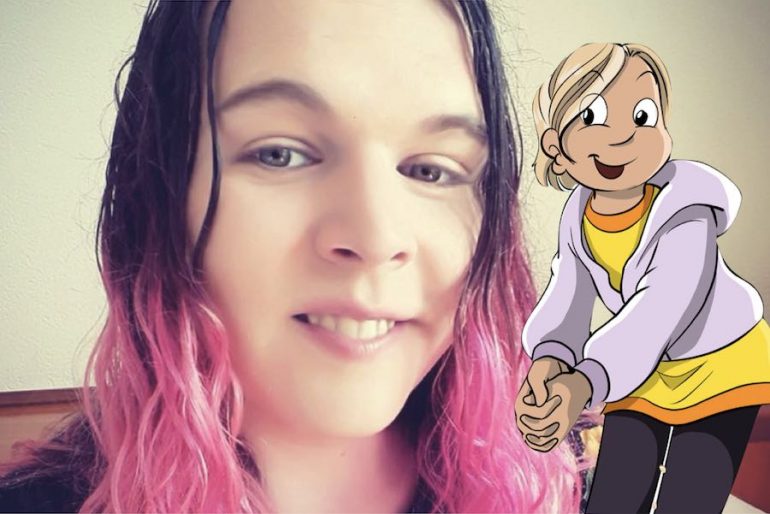
Sophie Labelle along with one of her characters name Ciel.

What I enjoyed especially regarding Sophie’s presentation was her humour and unstructured approach. This allowed for the audience to connect easily in regards to a topic that is not shared amongst everyone. She normalized the topic of LGBTQ by talking about it very casually and without a dramatic approach. Her intentions are not to define the community but simply to allow people to relate to these issues. I appreciate what Sophie stands for as an individual. Not only is she spreading awareness about such topics but she is also healing herself at the same time by creating comics and by the positive feedback her fans express.

As much as the unstructured approach to the presentation created an intimate setting, I felt it to be too informal for an auditorium. Maybe for future informal presentations, a smaller cozier room would be more appropriate. However in general I enjoyed the presentation as a whole and was eager to read some of her comics.

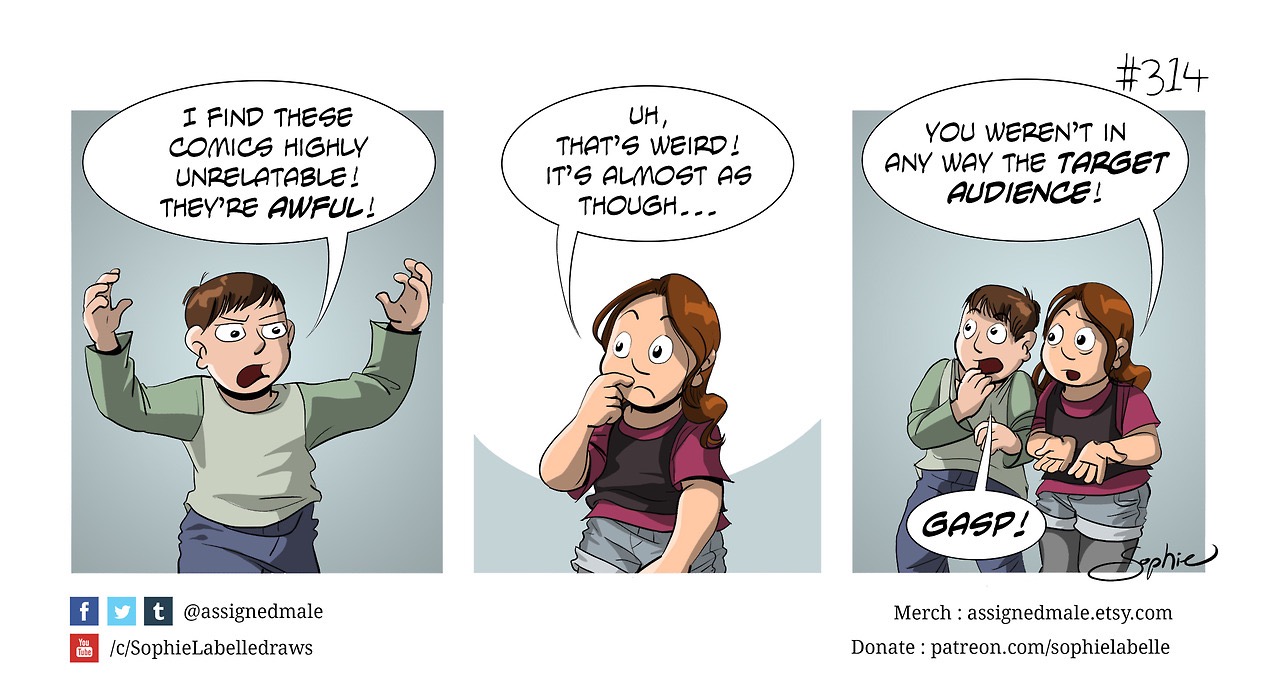
Here are some comics I enjoyed:

Related image
Related image
Related image

If you haven’t had the opportunity to check out her website, here it is!!!!: https://www.serioustransvibes.com/

Here is her twitter page for more content: https://twitter.com/assignedmale?lang=en

-Andrea Massarelli

Blog 6: Women’s Week – Sophie Labelle

On March 4th, Sophie Labelle came to Vanier College to speak about her comics and a representation of transgender people. What I immediately liked about her was how she did not have a planned presentation, and it felt more like just a conversation between her and the audience, which made the talk very enjoyable.

Labelle was an elementary school teacher, with the intention of creating open spaces for LGBTQ+ and marginalized students, which was important to her because she is transgender herself. She later started dedicating her career to writing. She writes and designs comics about gender stereotypes, LGBTQ+  themes and feminism. Her comics contain humor and sarcasm, and are a way of venting and appealing to other marginalized people who can relate to her work, feel empowered and know that they are not alone. I think her main messages was how marginalized groups should stgart to be treated and represented just like everyone else. She mentioned how transgender representations are too dramatic and stereotypical, and how members of the LGBTQ+ community are treated way too differently for no reason. Labelle believes “normal people” shouldn’t be a term used to describe people who identify themselves with the gender they were “assigned to” at birth, this should really be termed cisgender. It is not used often enough by people. She also talks about how it is exasperating when people who do not conform to the their “assigned” gender are labelled as “gay”. Her goal in her writing is to normalize marginalized members without some big educational intent. Labelle jokes about how her work is often wrongly labelled as “educational”, and how it just seems that way because she is representing people who are minorities. All she wants to do is write comics as a way to vent and as a form of relatability.  

A lot of other students have agreed with me in the fact that she has an amazing approach to public speaking. She is very real, uncensored, comfortable and casual when she speaks. This makes her very entertaining, relatable and approachable. She is appealing to a young audience which is great considering she has been working with and supporting the trans youth since she was a teenager.

I would highly recommend going to see one of her talks because she is an excellent representation of the trans community (that they are just like everyone else). I loved how she was not looking for pity, nor making it obvious that she has been through a tough time. She did briefly talk about her bullying, but she wanted the highlight of her talk to be about the support and comfort she has found in the trans community, instead of the marginalization she and many others face. She turns to humour and sarcasm: cracking jokes about common misconceptions about trans people, finding pride in having haters, and much more. How she manages to remain so positive is remarkable.

Here are some examples of her comics:

fumetto-assigned-male-intervista-in-italiano-3C2-KWa6XcAALKGjfumetto-assigned-male-intervista-in-italiano-2

Women’s Week: Sophie Labelle

Vanier students had the chance to meet many wonderful women during the week. One of them, Sophie Labelle was outstanding, perharps because of the difficult path that led her to identify as a women regardless of her sex. With an approach that was very little professional, but that appealed to students, she told us about transgender issues and her work that strives to view transgender person as normal.

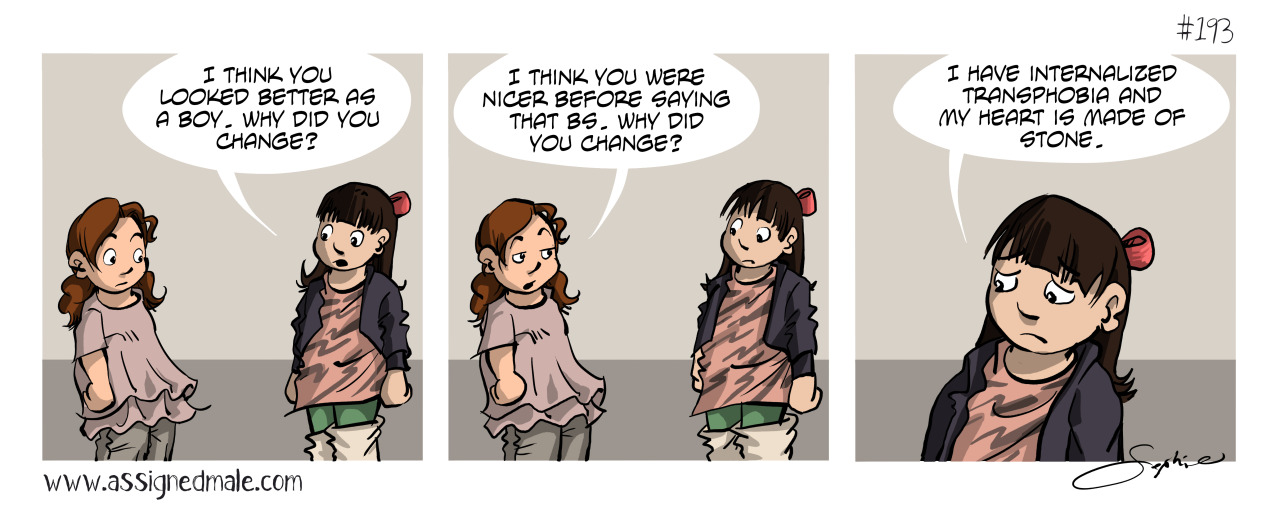
While, looking at Sophie Labelle’s work, I found this very ironic comic that illustrates well one of the main issue regarding trans people that was discussed: the difficulty for our modern society to include individuals being trans/queer. According to Labelle, one way to get through it nowadays is the internet. Communities allow this minority group to express themselves and to support each other. In a way, the comics that Sophie Labelle makes can help anyone to better understand trans reality and can help laugh about it.

Jokes are not only a tool to overcome difficulties, it is also a way to communicate according to Sophie. Her humour and her speech going in all directions were well appreciated by students. For many, it made it easier to listen to her. Perhaps, it made some of us forget about the assignment to come.

In her book, Labelle created two transgender characters that become friends without putting too much emphasis on this aspect of their personality. Different from most stories in books and movies, their difference doesn’t make their life dramatic. In fact, Sophie Labelle doest not like the fact most trans die in movies, because it is the only representation you can identify with theif you are trans. Even when her book came out, the public was surprised that two trans could be part of a story without much drama.

After the talk, I realized it is really hard to know how to behave in a way that is not offensive towards trans people since we don’t always understand their reality. Obviously, it does require changing things like our ways to speak and our tolerance of transphobic jokes. if one thing is interesting about the @AssignedMale twitter is that many jokes about trans reflect a reality that most of us are not well aware of. in other words, Labelle’s comics can help cis people to understand trans just as it can help trans.

In conclusion, I admire Sophie Labelle because she has the courage to speak about sensible subjects. the difficulties she faced within her own transphobic family/neighbourhood did not stop her from becoming the inspirational women she is today. How she faces the problem with humour makes it even more interesting and accessible. More people need to hear her words.

Blog 7: Sexual Violence Awareness

This is one of the best and most effective campaigns surrounding questions of sexual violence and awareness I have ever encountered. It is amazingly simple and straight to the point, and explains consent using everyday scenarios most people are bound to have encountered before. It is accessible, concise, and informative, and that’s why I find it very appealing as a resource.

Click to access saam_2015_what-is-healthy-sexuality-and-consent.pdf

In addition to the tea video, I really like this pamphlet on healthy sexuality and consent that was produced by the National Sexual Violence Resource Centre (NSVRC) for their 2015 Sexual Assault Awareness Month (SAAM) campaign. I often find that the media overwhelmingly portrays situations of dubious consent and unhealthy sexuality, so much so that adolescents and young adults have no idea what a healthy relationship and sexuality look like. This pamphlet helps give a clear picture of what a healthy experience should entail and helps to dispel many common misconceptions, such as the notion that asking for consent “will ruin the mood”.

Blog 6: Sophie Labelle| Assigned Male: Teaching About Identity Through Humour

The key message that I took away from this highly entertaining talk was the importance of representation of marginalized groups in the media. More specifically, I realized how important the healthy, balanced representation of such groups plays an important role in both how society comes to think of these people and how they come to think of themselves. In many ways this talk reminded me of Chimamanda Adichie’s “The Danger of a Single Story” TedTalk, wherein she identified how allowing a single narrative about a people, which may or may not be accurate, to become the only story that is told and known about them ultimately degrades them and takes away from their humanity. In a similar vein, Sophie Labelle stressed how her comics are about regular children who happen to be transgender; they have supportive families, healthy relationships, and partake in fun, age-appropriate activities. Showing situations where being transgender or gender non-conforming does not ruin someone’s life and plunge them into a pit of despair helps show society that the process does not have to be traumatic, as well as giving transgender youth something fun and lighthearted to relate to in their everyday lives.

The other students I spoke to likewise agreed and found Sophie Labelle’s talk very fun to listen to. Her casual approach to public speaking and lack of formal structure was refreshing and worked well with her personality and energy. The level of language used and humour employed was very relatable, especially for our age group and typical social settings, and so the general consensus seems to be that her message was well received and we enjoyed listening to her talk about her work, life, and experiences.

In addition to writing and drawing her popular webcomic Assigned Male, Sophie Labelle is a notable transgender rights activist, having advocated for Bill C-16, an act which added protections for gender expression and gender identity in the Canadian Human Rights Act and the Criminal Code. Making use of her background in education, she also produced sex education materials for TSER, a US-based organization focused on promoting the health and wellbeing of transgender youth.

Overall, I wholeheartedly recommend Sophie Labelle and her message to my friends. Her casual, unintimidating approach to transgender history, rights, and issues can open up a whole new realm of possibilities and perspectives in a fun and engaging way.

Blog 6: Sophie Labelle presentation

Sophie Labelle is a transgender while also working as a cartoonist with an inspiring goal to let her readers know in her comics the deep impacts that will make people understand more of the lgbtq community as who they are rather than to let the media or other people make baseless opinions that they would have against the lgbtq people.     

Furthermore, in her presentation she mentions a lot in despite being a transgender that she is not gay and wants to make people clear on the differences between being openly gay and a transgender. Moreover, she argues on the unfairness by assigning her birth as a male when she strongly believes gender to be a social construct and to be label as something she truly does not feel she belongs in the masculine category.   

Nevertheless, in order to spread her message to be understood by others she wrote many stories and online comics that she posted on her own web about her own experiences as a transgender. Also the misconception that the world has on the lgbtq to be shown to her readers, and other people going to the same phase as her to be open and accepting on transgender and queers.

I think in my opinion, that it is true that many people still do not have a good understanding on transgender, and the whole lgbtq community probably because we are living in a society that goes through a rapid change every year; and there is always something new that we do not know them. Moreover, current situations that is happening or new rules that has been past down or even the transgender having to be murder by people who simply detest them just for who they are. Which is a problem in our lack of understanding on the lgbtq and Sophie’s presentation.

Blog 5: Culture and Diversity

It is true that men and women are very different when it comes to biology, which is why it has given them the concept in creating genders that could be define as masculine for men and feminine for women. In the essay of Gender and Cultural Diversity it explain how gender is uniquely different for both the Native Americans and Europeans who settle in the native land for their mercantilism goal by  promoting Catholicism and fur trades, which it lead to force assimilation to the native people and losing their unique gender roles (P. 20).

Furthermore, the aboriginal people for men and women treated each other’s as equal when it comes to gender roles since women can become shaman, healers, and make political or family decision that is usually for the men to do (p.17). Moreover, the Aboriginal treated women with much respect since they can also take leadership and provide hunting and food gathering for their community, which is much different from western European concepts of gender.

Westerners concept on gender is heavily base on masculinity because a to do with their religious belief into being the Godly father head for the family and the women had to play as the supportive for the husband all needs and desires (p.21). Nevertheless, of courses western women also had some major roles that are not always overlook such as having some decision making in selling properties because the husband cannot sell his land property without consulting his wife first. Which is still something and a right that western women has compared to the native women who happen to have more rights and political decision to influence their community.

When the French and English settle in the native land, their first impression on them was that they consider them as noble savages, childlike innocent or as heathen for not believing in one God and the masculine and feminine roles that the natives ought to play in (P. 24). However, that also lead them to perceived the aboriginal men to be weak and feminine and as for the women to be hypersexual because of their practice of having sex before marriages.

Sophie Labelle

International Women’s Week

Sophie Labelle is a Canadian cartoon artists who touched me the moment she started her presentation. She is extremely genuine and her humour creates a connection with her audience. Sophie came to Vanier as a guest speaker and it was the first time I ever heard of her. Once the presentation was over the first thing I did was read some of her cartoon strips. The cartoon strips are funny and shed light on transgender topics that are never spoken about. Even if Sophie’s works are slightly exaggerated they still present real matters at hand.

After talking to a few of my classmates, it was very obvious that everyone loved Sophie and felt she brought light into the room. It was easy to follow and kept the audience constantly interested.

some of my favourites upon research:

gallery photo
Image result for sophie labelle comic strips

Blog 5: Gender Equity in Aboriginal Culture

In our everyday lives men and women have been put into sections. In society’s eyes men have been seen as the stronger and aggressive people and women as the more sensitive and caring person. Which shouldn’t be the case because we have put this image across generation. In the text “Gender and Cultural diversity in the Early Contact Period”, the author describes how differences in sexes for the Aboriginal culture and some of the tasks they separated among  each others.

Unfortunately, women in present day aren’t respected enough and this is absurd. During the Aboriginal era, women we’re very respected and powerful. They did as much work as men. It was very equal and not gender based. Men hunted the big animals and fished but women also hunted even if the animals we’re smaller they still did the same amount of work as men. They carried their kids and they cooked for their family. They also assigned who was going to be the chief among men.

When the Europeans arrived they tried to spread Christianity on the Aboriginals. The French we’re very religious and believed in marriage. They also tried to take over their land. They we’re much richer than the Aboriginals and they had the upper hand. Therefore is was very unfortunate for the Aboriginals.

I believe that in our culture, we should be more similar to the Aboriginal people because women are treated equally. In our present day we have a lot of gender discrimination and it always causes problems. Therefore if we can fix these issues that society has caused during these years they’re wouldn’t be such a gender problem. The Aboriginal way of gender role is a good way of viewing how our society should be like.

Diane Labelle talked about how we took so much of the Aboriginals land and now they live in very poor conditions. They don’t have access to education because it costs money to go to the school. Furthermore they believed that education from an indigenous perspective does not schedule things. Everyone is different and learns differently some learn faster then others.